Sealcoating Lansing Call (517) 793-5496
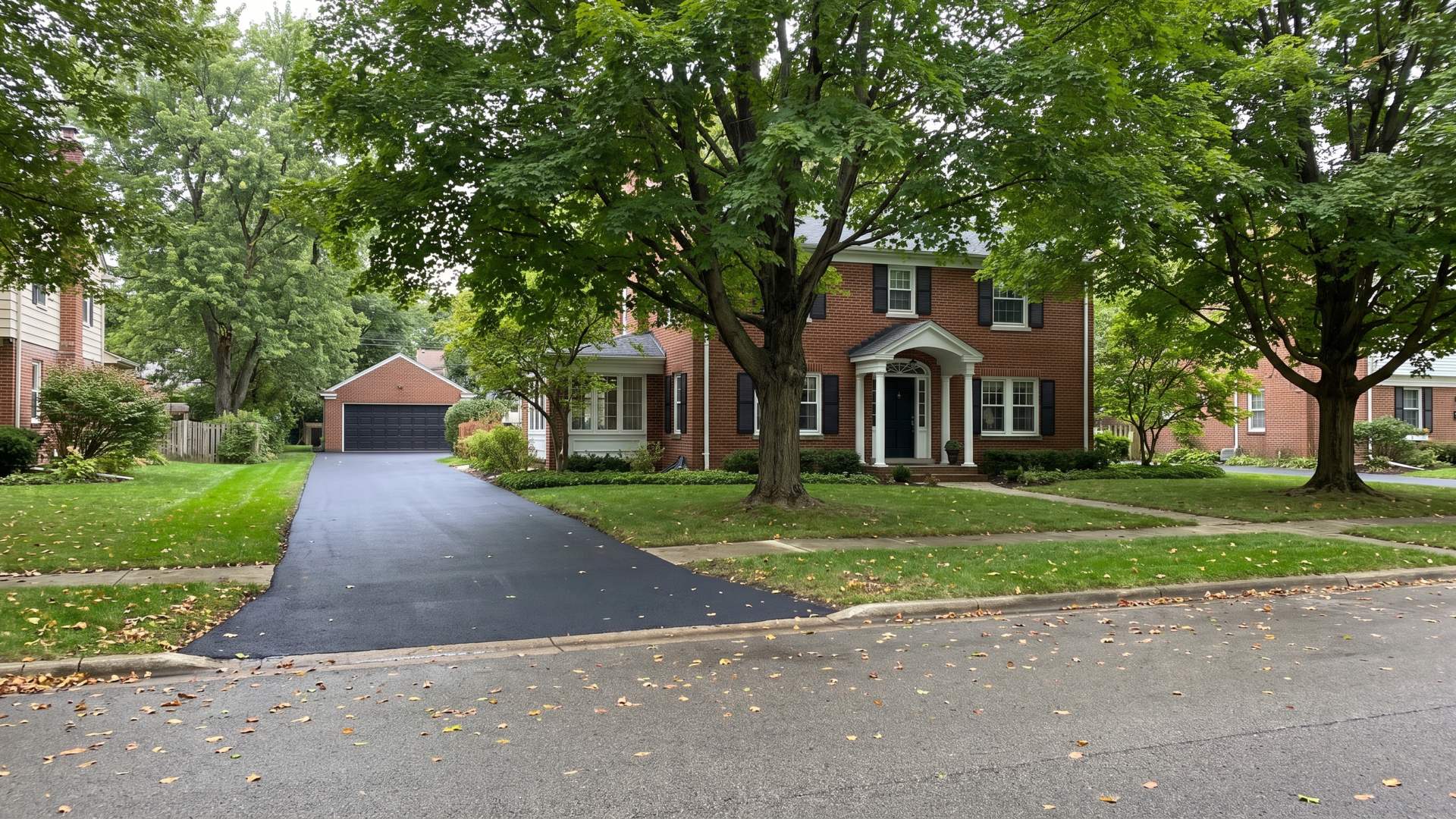
Under maples on an overcast day, fresh sealcoat leads past a red brick colonial with a white portico to a matching detached garage

Sealcoating Lansing

(517) 793-5496

Free Lansing-area quotes for driveways and lots.

Lansing Driveway and Parking Lot Sealcoating

At the weather station northwest of downtown Lansing, roughly 80 days a year begin under 32 degrees and finish over it, and March alone accounts for 17.8 of them. Sealing, crack filling and patching are how asphalt gets through that.

  • 80 freeze-thaw days a year at the Capital Region airport station (NOAA 1991-2020)
  • Median Lansing home built in 1959; about one in four predates 1940 (ACS 2019-2023)
  • Sealing window sits between the May 2 last-frost and October 9 first-frost medians
Why seal here

What sealer does for asphalt that freezes and thaws 80 times a year

Seal coating spreads a thin film of asphalt emulsion over pavement that has been cleaned and repaired. It shields the binder that holds the stone together from the two things that age it fastest: sunlight, which oxidizes the binder until the surface turns gray and brittle, and water, which soaks into open pores and cracks. Around the capital, water is the larger threat. Lansing's long-term NOAA station at Capital Region International Airport logs 131 nights in a normal year that drop to 32 degrees or lower, and on 80 of those days the afternoon climbs back above freezing. Every one of those days freezes and thaws whatever water is sitting inside the asphalt.

The calendar makes it worse. NOAA's monthly normals place 17.8 of those crossing days in March, when the snowpack is melting and the ground under the pavement is often still frozen, so meltwater cannot drain downward and stays trapped in the base instead. That is why holes and broken edges show up in March and April rather than January, and why driveway sealing, crack filling and patching here belong in one planned sequence instead of three separate purchases. The pothole season guide lays that sequence out month by month.

Old pavement adds a second layer to the problem. The Census Bureau's 2019-2023 survey puts the median year built for the city's housing at 1959, and just over half of its homes went up before 1960. On a lot that old, the first question is what lies under the surface: an original drive, a replacement, or an overlay laid over older asphalt that can crack along buried seams. A crew that probes the surface and edges before quoting avoids sealing over a problem that will reappear by the next thaw.

This site covers Lansing and the towns around it, including East Lansing, Okemos, Holt and DeWitt. Each service page explains what the work is, what an owner can see that calls for it, and what published cost guides report it costs; the price ranges are collected in one place with their sources. Filling in the quote form passes the job details along to independent local contractors, and each replies with a price of its own. The site does not do the work itself and does not inspect pavement in person.

Free quote

Fields marked * are required.

Fast response during business hours. No obligation.

Seven services

From hot-poured crack fill to new driveways, priced for Ingham County

Red maple leaves dot the faded street end of a drive whose garage end gleams with new sealcoat beside a white clapboard colonial

Driveway Sealing

Cleaning, crack prep and an emulsion coat for residential asphalt, timed to the June-to-September stretch when Lansing nights stay above 50 degrees and the coating can cure.

Typical: $210 - $800 on a typical two-car drive; $0.30 - $2.00 per sq ft

Maple seeds and tiny red blossoms lie around a thick bead of black filler sealing the seam between cracked asphalt and concrete sidewalk

Crack Filling

Hot-poured rubberized sealant in cleaned cracks, done before sealing and ideally before November, when Lansing pavement starts its fall run of 13 freeze-thaw days.

Typical: $1 - $3 a linear foot, or about $100 - $400 for a typical drive

Yellow daffodils bloom beside a fresh, dark asphalt patch where a driveway meets the wet street below a brick colonial

Pothole and Asphalt Patching

Cold-patch stopgaps, compacted hot-mix fills and saw-cut full-depth patches for potholes, soft spots and broken edges left by a Lansing spring thaw.

Typical: $100 - $400 a pothole; hot-mix patches $2 - $5 per sq ft

Orange autumn trees flank a long flat-roofed building with ribbon windows, the stalls along it newly sealed and the near rows cracked and faded

Parking Lot Sealcoating

Phased sealing for apartment, church, office and retail lots around Lansing and East Lansing, with extra coats on drive lanes and restriping planned into the same closure.

Typical: $0.20 - $0.50 per sq ft sealed; up to $0.90 with cracks and lines included

Fallen red and orange leaves drift against the curb above new stall lines on black sealcoat, maples blazing on the lawn beyond

Line Striping and Layout

Stall lines, accessible spaces, arrows and crosswalks repainted after sealing or laid out new, with the federal accessible-parking counts checked before the paint truck arrives.

Typical: $4 - $5 a standard stall; accessible stalls $25 - $40; setup $150 - $350

Beneath a gray sky, fiery maples line a dark, resealed lot with crisp stall lines before a steepled, white-columned brick church

Asphalt Maintenance Plans

A year-by-year schedule of inspections, crack filling, patching, sealing and striping for lots and long drives, built around Lansing's frost dates instead of a generic calendar.

Typical: $0.20 - $0.50 per sq ft per sealing cycle, plus crack filling at $1 - $3 per linear ft

Black shutters trim a white clapboard colonial as steam lifts off its freshly laid driveway, a cream roller parked near the detached garage

Asphalt Paving and Replacement

New drives, replacements and overlays around Lansing: base depth for wet till soils, road-agency permits for new approaches, the warm-weather paving months and the cure before first seal.

Typical: New or replaced: $5 - $15 a sq ft; overlays $1 - $7 a sq ft

Why this site starts with the airport weather station

Built on the airport station's record

Every timing and weather statement on this site traces to the 1991-2020 climate normals NOAA publishes for the Capital Region International Airport station, the record behind the city's climate normals. A national sealing article cannot tell a reader that March averages 17.8 freeze-thaw days here, or that the median first fall frost arrives on October 9. Those two numbers decide when patching makes sense and when sealer will cure.

Soil and road facts from the agencies that own them

Soil descriptions come from the USDA survey of Ingham County and the official series descriptions for Capac, Marlette, Colwood and Houghton soils. Street mileage, snow rules and right-of-way permits come from the City of Lansing, the City of East Lansing, Meridian and Delhi townships and the City of DeWitt. Where a rule changes at a township or city line, the page for that town says so.

Prices published before anyone knocks

The cost page lists observed ranges from HomeBlue's Lansing figures and from national guides by HomeGuide, Angi, HomeAdvisor, Fixr and FixAsphalt, and it names the guides behind the figures. Knowing the range first lets an owner judge a quote against the market rather than against the first number offered at the door, a pattern the Asphalt Pavement Association of Michigan cautions about when it discusses door-to-door paving offers.

Quotes come from independent contractors

The quote form passes a plain job description to independent contractors who work in the Lansing area. They price the job themselves, schedule their own crews and answer for their own work, and the owner decides. Because this site sells no sealer and runs no crew, its pages can say when a driveway needs nothing more than a crack fill, or nothing at all this year.

Job sequence

The order of work between the May thaw and the October frost

  1. Inspect after the spring melt drains

    A useful walk-around waits until the thaw has drained away, which around Lansing usually means after the median last frost of May 2. There are three things to sort: a gray, open surface that only needs sealer; cracks that need filling first; and soft, sunken or broken areas, often at the street edge or below a downspout, that need patching before anything else goes down.

  2. Repair in the right order

    Patches go in first, since new hot mix has to harden before it can take a coating; SealMaster puts that wait for new asphalt at 30 to 60 days. Cracks come next, blown clean and filled with a hot-poured rubberized sealant that stays flexible through winter. Oil and gas spots get a primer so the sealer can grip. Only then is the whole surface cleaned for coating.

  3. Coat on a warm, dry stretch

    SealMaster's application guide says not to coat if the temperature will dip below 50 degrees, or rain is expected, within the following 24 hours. Lansing's normal overnight low stays above 50 only from June through September, so late May to mid-September is the dependable window, with May and early October usable on warm runs. Edges along the lawn and garage slab get worked by hand so the coat reaches the margins.

  4. Keep tires off, then plan the next round

    The coating needs about a day before cars return, and longer in cool, humid weather. After that the calendar matters more than the product. A winter of 80 crossing days reopens some cracks, so a quick fill each spring keeps water out, and Angi's guide puts full resealing at every two to five years depending on the sealer used.

Ground truth

Glacial till, two rivers and 410 miles of city streets

The city's long-term NOAA climate record comes from Capital Region International Airport, formerly Capital City Airport, which sits in DeWitt Township about three miles northwest of downtown. Its 1991-2020 NOAA normals count 131 nights a year that reach 32 degrees or colder and 51 days that never climb past 32. Take the second figure from the first and about 80 days remain on which pavement goes through a full freeze and thaw. March leads with 17.8 of them, November follows with 13.0 and December adds 12.6. January, colder and more steadily frozen, has only 9.5. The median last spring frost is May 2, the median first fall frost October 9, and the season between them runs 158 days.

Snow supplies much of the water that freeze-thaw needs. The station averages 51.1 inches a season, 38.4 inches of it in December, January and February, and on 16.3 days a year the snowfall reaches an inch or more. Total precipitation is 31.77 inches spread across 69 days with at least a tenth of an inch, and September and June are the wettest months at roughly 3.5 inches each. September's rain arrives just ahead of the first frost, so a crack left open in September is holding water when November's 13 crossing days begin.

Ingham County sits on glacial deposits. The USDA soil survey of the county groups its ground into seven soil associations, and the loamy till soils called Marlette and Capac appear in four of them, which together cover about 73 percent of the county. Capac drains somewhat poorly; its seasonal water table can sit 15 to 46 centimeters, roughly 6 to 18 inches, below the surface. Marlette drains better, with its water table 2 to 6 feet down between October and May. Lower ground holds poorly drained Colwood soils and Houghton muck, and a base course over those stays wet longer each spring than one over the sandy, well-drained Oshtemo soils found on outwash.

Housing age shapes the pavement. In the Census Bureau's 2019-2023 survey estimates, the city has 55,943 housing units with a median construction year of 1959, and 24.5 percent were built in 1939 or earlier. The suburbs are younger: the median home in Okemos dates to 1983, in DeWitt to 1985 and in Holt to 1989. On a city lot occupied for six or seven decades, the drive may be original, rebuilt or overlaid, so a careful estimate starts by checking which, since an overlay cracks along the joints and cracks buried beneath it.

Streets inside the city belong to Lansing's Public Service Department, which is responsible for 107 miles of major streets and 303 miles of local streets and keeps a potholes page explaining how holes are fixed, how to report one and how to locate them. Outside the city the owner changes: in Meridian Township, MDOT handles Grand River Avenue and Saginaw Street and the Ingham County Road Department handles the rest. Michigan's driveway law, Act 200 of 1969, makes a driveway onto a state trunkline or county road lawful only under a permit from that agency, while cities regulate their own streets. State law also lets road agencies cut legal axle loads during March, April and May, by 35 percent on roads other than concrete.

Runoff from driveways in the area drains toward three rivers. The Grand, the longest river in Michigan at 252 miles, meets the Red Cedar in the city after the Red Cedar's 51.1-mile run through Okemos and the Michigan State University campus, and DeWitt drains to the Looking Glass. Seventeen local governments and institutions, among them Lansing, East Lansing, DeWitt, Delhi and Meridian townships and MSU, coordinate their stormwater programs as the Greater Lansing Regional Committee. Michigan has no statewide coal-tar sealer ban, but East Lansing appears on the national list of communities capping sealer PAH content at 0.1 percent, a limit coal-tar products exceed many times over.
Price ranges

What sealing, patching and striping cost around Lansing

Every figure below is a range seen in published cost guides, not a quote and not a price list. The Lansing numbers come from HomeBlue's page for the city; the rest come from national guides by HomeGuide, Angi, HomeAdvisor, Fixr and FixAsphalt, and this site's notes record which guide backs each row. National averages tend to run above the Lansing figures, so the spread in each row is real. A contractor who has walked the pavement will price the actual job, and that is the only number that counts.

Service Typical Lansing Range
Two-car driveway, cleaned and sealed (400 - 720 sq ft) $210 - $800
Driveway sealing, by the square foot $0.30 - $2.00 per sq ft
Mobilization fee on a small driveway $75 - $100
Crack filling with hot-pour sealant $1 - $3 per linear ft
Owner questions

What Lansing property owners ask before sealing

What does driveway sealing cost in Lansing?

HomeBlue's Lansing figures, last revised in 2022, come to $210 to $350 for a two-car drive of 720 square feet, 24 by 30, or 30 to 50 cents per square foot; small jobs may also carry a setup charge of $75 to $100. The national guides come in higher: Angi and HomeAdvisor quote $1.25 to $1.50 a square foot, with most jobs landing between $282 and $868. Extras such as crack filling, patching and oil-spot priming are billed on top. The cost page collects the full set of ranges and the guides behind them.

Which months suit sealing around Lansing?

Roughly late May through mid-September. The coating wants at least 50 degrees and climbing through a whole day, a dry surface and a day without rain. The normal overnight low at the airport station is 46.7 degrees in May and does not stay above 50 until June; by October it is back down to 40.7. With the median last frost on May 2 and the median first frost on October 9, May and early October work only during warm stretches, while June through September carries the dependable days.

How many years can a sealed drive go before the next coat?

Angi's guide puts the interval at two to five years depending on the type of sealer, and HomeGuide gives a wider two to ten. The surface itself is the better signal. When a drive has faded from black to gray, when loose stone shows on the surface, or when rain soaks in instead of running off, the coating has worn through. A drive that still looks dark after two winters can usually wait, while one that sits in full sun and takes daily traffic will wear faster.

Is coal-tar sealer allowed in Lansing and East Lansing?

Michigan has no statewide ban; the restrictions are local. East Lansing appears on Coal Tar Free America's list with a limit of 0.1 percent PAH content, equal to 1,000 mg in each kilogram of product. The U.S. Geological Survey measures coal-tar sealcoat at 34,000 to 202,000 milligrams per kilogram, so coal-tar products cannot meet that cap. Lansing, Meridian and Delhi townships and DeWitt were not on the list when this page was written. Asphalt-emulsion sealers are available and legal in all of them.

Why does Lansing pavement break up in March?

March has the most freeze-thaw days at the airport station, 17.8 in a normal year, because its normal low is 26.0 degrees and its normal high 44.1. Melting snow supplies water while the ground below is often still frozen, so the water cannot drain down. Pavement Interactive calls the result thaw weakening: a saturated subgrade that loses bearing capacity. Tires then flex the unsupported surface, cracks join up, and pieces break loose, which is why holes seem to appear overnight in late winter.

Can sealer be spread over potholes or alligator cracking?

No. Sealer is a thin film, and it follows the surface it is spread on, so it bridges nothing. A pothole needs a patch, compacted hot mix once the hole is dry and warm enough. Alligator cracking, where the surface splits into small linked plates, signals a failed base under that area, and the lasting fix is to cut it out and rebuild it. Seal coating spread over either leaves the damage in place, still open to water, under a fresh black color.

Which driveway jobs need a permit around Lansing?

None of the local permit pages reviewed for this site treat sealing as permitted work; the rules begin where a driveway meets the road. Under Michigan's Act 200 of 1969, a driveway onto a county road or state trunkline needs a permit from that road agency, which in Meridian and Delhi townships means the Ingham County Road Department or MDOT. East Lansing issues its own right-of-way permit, and DeWitt uses a right-of-way application with 24 hours' notice before work begins.

How soon can a car park on a newly sealed Lansing drive?

SealMaster's rule is to hold all traffic until 24 hours after the final coat, and cool or humid weather stretches that. Lansing's summer helps, with normal highs of 78.4 degrees in June and 82.4 in July, but turning a steering wheel while parked can still scuff a young coat. Owners who plan to park on the street during the cure should check the local rule first; East Lansing, for one, bans street parking on every street from 2 to 6 a.m.

Does wet clay under a driveway change the plan?

It changes the order of work more than the product. On Capac soils the seasonal water table can rise to within 6 to 18 inches of the surface, so a base over them stays damp well into spring. Before sealing, it pays to deal with what feeds that water: downspouts that empty onto the drive, edges where the lawn sits higher than the asphalt, and open cracks along the garage slab. Sealer does nothing about water arriving from below or from the sides.

What happens after a quote request is sent?

The form passes the job description and the town to independent contractors who serve the Lansing area. They contact the owner, look at the pavement and quote their own prices, and the owner is free to compare those quotes with the published ranges before agreeing to anything. Asking each contractor whether the price includes crack filling, oil-spot priming and hand work at the edges keeps the comparison fair, because a low number that leaves out the cracks is not the same job.

Coverage

Capital neighborhoods and the towns around them

Downtown Lansing Old Town REO Town Eastside Westside Southside East Lansing Okemos Holt DeWitt DeWitt Township Bath Township Mason Delta Township Lansing Charter Township Grand Ledge Williamston Dimondale

Ask Lansing-area contractors to price the job

Describe the driveway or lot and its town, and independent contractors who work across Ingham, Clinton and Eaton counties will be asked to price it.

Free quote

Fields marked * are required.

Fast response during business hours. No obligation.